Who Should Be Doing Your Cosmetic Surgery?! Do Not Become Someone’s Sandbox!
Choosing to undergo cosmetic surgery is a life-changing decision. Beyond deciding what you want to change, the single most critical choice you will make is who will operate on you.
Many patients assume that any licensed doctor holding a medical degree is fully qualified to perform any surgical procedure. Unfortunately, this confusion is often weaponized by clever marketing and misleading titles like "Cosmetic Surgeon."
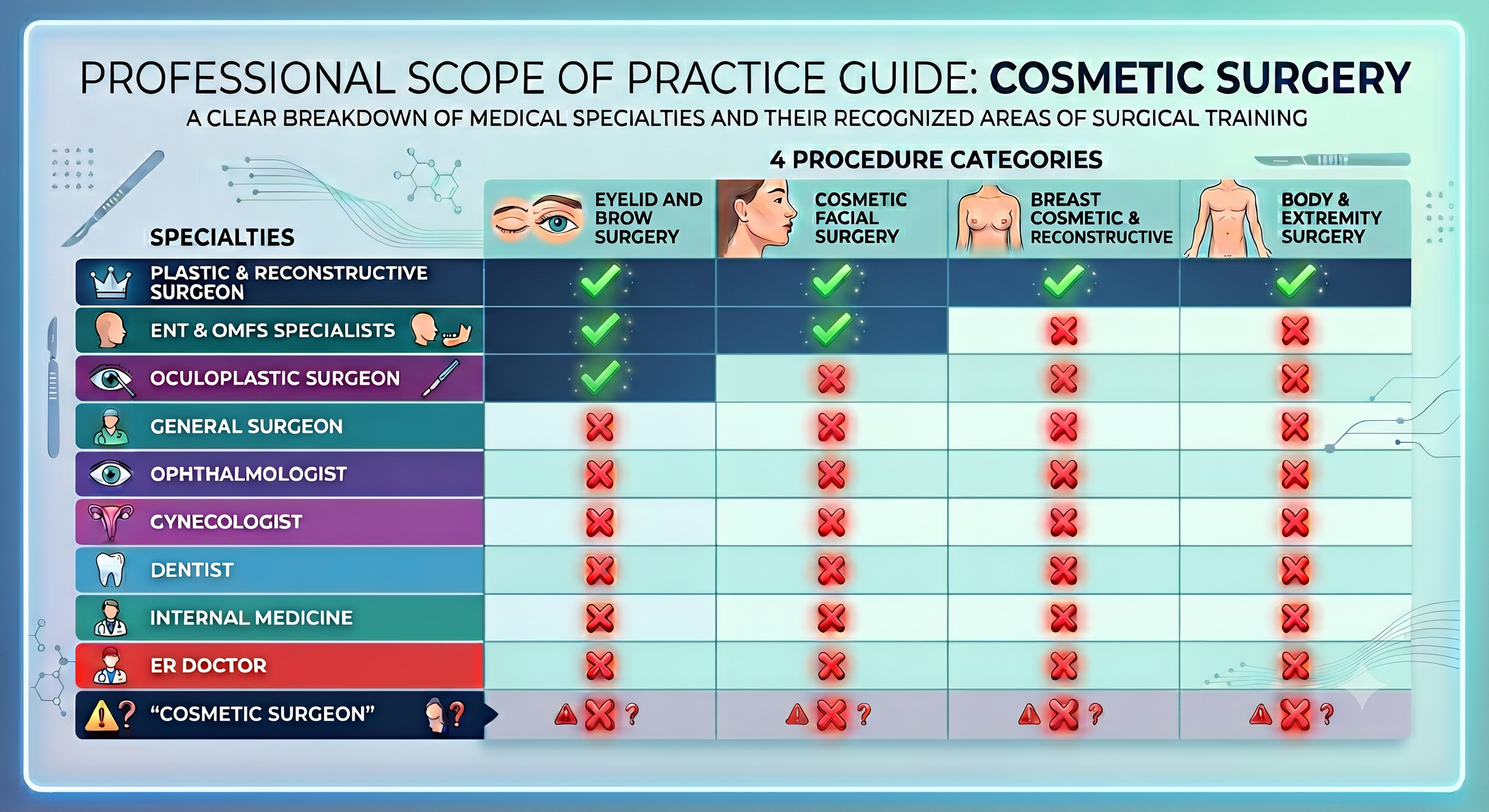
To help clear up the confusion, we’ve laid out a direct, no-nonsense matrix mapping exactly which medical specialties possess the rigorous residency, fellowship, and board-certified training required to perform specific cosmetic procedures.
The Breakdown: Which Surgeon Handles What?
1. The Plastic & Reconstructive Surgeon
Qualified Scopes: Eyelid & Brow Surgery, Cosmetic and reconstructive Facial Surgery, Breast Cosmetic & Reconstructive Surgery, Body & Extremity Surgery.
The Reality:Board-certified plastic and reconstructive surgeons are the only specialists whose formal, accredited residency training encompasses the entire human body. From head to toe, they have mastered both the aesthetic and reconstructive principles required to navigate safe surgical outcomes.
2. ENT (Otolaryngologists) & OMFS (Oral & Maxillofacial Surgeons)
Qualified Scopes: Eyelid & Brow Surgery, Cosmetic Facial Surgery.
The Reality: These specialists undergo intense, multi-year training exclusively focused on the complex anatomy of the head, face, and neck. Because of this specialized regional focus, they are highly qualified to perform cosmetic facial surgeries (such as rhinoplasty or facelifts) and delicate surgeries around the eyes, including eyelid and brow lifts. However, their scope explicitly stops at the neck.
3. Oculoplastic Surgeons
Qualified Scopes: Eyelid & Brow Surgery.
The Reality: Oculoplastic surgeons are ophthalmologists who have completed highly competitive, specialized fellowships dedicated purely to the plastic and reconstructive surgery of the eyelids, orbit, and adjacent structures. If your goal is strictly an upper/lower blepharoplasty or a brow lift, they are excellently trained for it. They do not cross over into full-body or broader facial cosmetic procedures.
The "Zero Scope" Category: Who Should Not Be Performing Cosmetic Surgery?
When a medical professional operates outside their formal scope of training, patient safety risks skyrocket. The following specialties have no formal, residency-backed scope of practice in cosmetic surgery:
Ophthalmologists (General): While vital for vision care and eye health, general ophthalmologists DO NOT have the advanced plastic surgery training of their oculoplastic peers.
General Surgeons: Trained to operate inside the abdomen, remove tumors, and manage soft tissue trauma—not to sculpt aesthetic breast implants or perform facelifts. Only general surgeons who have finished an accredited plastic and reconstructive surgery training and are board certified are eligible to perform cosmetic surgery.
Gynecologists, Dentists, & Internal Medicine/ER Doctors: Though experts in their respective fields, they possess zero formal training in multi-layered aesthetic plastic surgery.
The Biggest Danger: The Self-Titled "Cosmetic Surgeon"
Perhaps the most dangerous title in the entire aesthetic industry is "Cosmetic Surgeon." It is vital to understand that a "cosmetic surgeon" is a doctor who is not a board-certified plastic surgeon. They are often family physicians, emergency room doctors, or general practitioners who dream of being plastic surgeons but want to bypass the grueling 6 to 8 years of an accredited plastic surgery residency. Instead, they take weekend courses or join unaccredited, self-made societies to obtain unofficial certificates.
Legally, a medical license allows any doctor to perform almost any procedure, but ethically and practically, they lack the structural safety training to handle complications.
Protect Yourself: Check the Board, Not the Title
When researching a doctor, look past the glossy Instagram photos, the pristine office, and the generic "Cosmetic Surgery" signs. Ask the hard question: "Are you board-certified by the American Board of Plastic Surgery (or your country's equivalent official medical board)?" Your safety, your health, and your results depend entirely on putting your body in the hands of someone whose actual training matches the procedure they are executing. Use our scope guide as your baseline checklist before booking a consultation.